
Retatrutide: Triple-Agonist Research Compound Overview
A structural and mechanistic overview of the GLP-1/GIP/glucagon triple-receptor agonist, and the metabolic, hepatic, and structural research domains it has been studied in.
For Research Use Only — Not for human or veterinary use.
You must be 21 years of age or older to enter this site. By entering, you confirm that you are 21 or older, and that any products purchased will be used solely for laboratory research purposes — not for human or veterinary consumption, diagnostic, or therapeutic use.
A research overview of the pineal-derived tetrapeptide Epithalon, its proposed telomerase-activation mechanism, and the cellular-senescence and lifespan research domains it has been studied in.
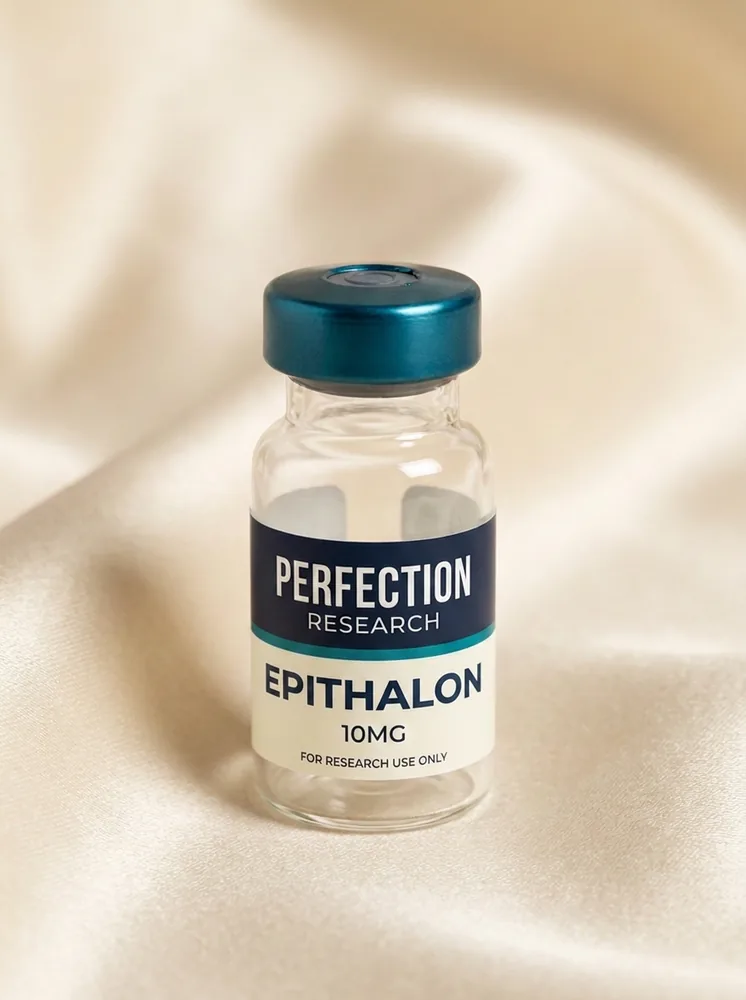
All content on this page is for laboratory and academic reference only. This compound is supplied under a Research Use Only framework for in vitro and preclinical investigation by qualified personnel. Nothing on this page is clinical guidance, and it should not be interpreted as instructions for use in humans or animals.
Epithalon (also spelled Epitalon) is a synthetic tetrapeptide with the sequence Ala-Glu-Asp-Gly (AEDG), developed by Vladimir Khavinson's laboratory at the St. Petersburg Institute of Bioregulation and Gerontology as a simplified synthetic analog of Epithalamin, a bovine pineal gland extract studied since the 1970s. Epithalon research has focused predominantly on cellular aging and geroprotective research questions.[1]
The mechanism most associated with Epithalon in the literature involves telomerase, the enzyme responsible for maintaining telomere length at the ends of chromosomes. In telomerase-negative human fetal fibroblast cultures, Epithalon was reported to induce expression of the telomerase catalytic subunit (hTERT), increase telomerase enzymatic activity as measured by TRAP assay, and produce telomere elongation over the culture period.[2] A companion study from the same research group reported that Epithalon-treated fibroblast cultures exceeded the conventional "Hayflick limit" — the number of divisions a normal cell population can typically undergo before senescence — by roughly ten additional population doublings relative to untreated controls.[3] A 2025 review notes that Epithalon's studied effects extend beyond telomerase activity to antioxidant, neuroprotective, and antimutagenic research domains, suggesting multiple mechanisms rather than a single pathway.[1]
Epithalon is mechanistically distinct from the other longevity-research compounds in this catalog. Where NAD+ research centers on redox coenzyme and sirtuin-cofactor activity, Epithalon's primary research mechanism is telomerase activation and telomere maintenance — a separate cellular pathway relevant to replicative senescence rather than energy metabolism.
A Certificate of Analysis for an Epithalon research vial should report, at minimum: confirmed amino acid sequence (typically via mass spectrometry) and net peptide content. Vials should be stored lyophilized at -20°C, protected from light, consistent with handling guidance for the other lyophilized peptides in this catalog.
Epithalon is a synthetic tetrapeptide developed as a simplified analog of Epithalamin, a bovine pineal gland extract.[1]
Research centers on telomerase activation — in vitro studies report increased telomerase enzymatic activity and telomere elongation in fibroblast cultures following Epithalon exposure.[2]
Yes. A controlled mouse study reported increased survival among the longest-lived animals and increased maximum lifespan, though mean lifespan was not affected.[4]
No — review literature also describes studied antioxidant, neuroprotective, and antimutagenic research domains, suggesting Epithalon's effects may involve multiple mechanisms.
A COA for an Epithalon research vial should report confirmed amino acid sequence and net peptide content, consistent with the documentation standard used across this catalog.
No. Epithalon is supplied strictly under a Research Use Only framework for laboratory and preclinical investigation, and none of the studies referenced here involve clinical administration guidance.
A structural and mechanistic overview of the GLP-1/GIP/glucagon triple-receptor agonist, and the metabolic, hepatic, and structural research domains it has been studied in.

A research overview of the gastric-derived pentadecapeptide BPC-157, its proposed VEGFR2/angiogenesis and growth-hormone-receptor mechanisms, and the tissue-repair, GI, and neurological research domains where it has been studied.

Chemistry, proposed mechanism, and the research domains — cardiac, ophthalmic, and general tissue repair — where the Thymosin Beta-4 fragment appears most in the literature.